

I set out to evaluate Good Man Casino’s table games with one definite goal: determine how the different blackjack variants work and whether the site provides you enough variety to maintain engagement. After hundreds of hands across several versions, I noticed right away that small details like how many decks are used or whether the dealer checks for blackjack under a ten can alter the whole flow of a session. The lobby doesn’t just present a few standard tables. It showcases a real mix of blackjack styles, from classic single-deck games to feature-packed live dealer releases. That variety counts because sitting down at the wrong variant for your strategy or bankroll can chip away at your edge without you even realizing. I’ll walk through the key rule differences, the ones that actually shift the house edge, and how casino good man review lets you to move between them easily. This isn’t a generic rulebook. It’s a closer look at what renders each blackjack variant operate and where careful players can discover real value.
The Reason Understanding Blackjack Variants Proves Essential
Most casual players treat all blackjack tables the same way, but that assumption hurts your bankroll. A rule like dealer stands on soft 17 compared to dealer hits soft 17 alters the house edge by roughly 0.2%, and that’s only one instance. Over hours of play, the variant you select becomes the largest factor in your long-term results. Good Man Casino’s lobby clearly labels each game’s rules, which helps a lot compared to sites that hide the details behind a generic thumbnail. You’ll see tables where doubling after split is allowed and others where it isn’t. Some provide late surrender, while classic single-deck games often limit doubling to hard totals only. Every tweak modifies basic strategy. My rule is simple: before you place a bet, check carefully which rule variations are active, because a table that seems generous might still have a higher vig due to a payout change like 6:5 blackjack instead of 3:2. The ability to filter and compare quickly in Good Man Casino’s interface means you use less time looking and more time taking advantage of favorable spots.
Real-Time Dealer Blackjack – Real Casino Atmosphere
The Social and Visual Aspect

Moving to the live dealer section at Good Man Casino boosted the immersion level right away. Real human dealers, streamed from professional studio setups, distributed actual cards on physical tables while a chat box allowed me to communicate with the dealer and occasionally other players. The video quality was sharp, with multiple camera angles that eliminated any doubts about card visibility. The dealer answered chat messages verbally, which mirrored the social feel of a brick-and-mortar casino floor. Latency was insignificant, and the interface allowed me to put bets smoothly with clear countdown timers, so I didn’t feel pressured but also skipped long idle gaps. For me, live blackjack shines because of the small human touches, the dealer’s pace, the way they flip cards, that an RNG simulation simply cannot replicate. It also creates trust. Watching a real deck being shuffled and dealt erases any hidden suspicion about computerized fairness. Good Man Casino’s live lobby organized blackjack tables by stake level and rule variation, so I could jump into a seat without waiting. If you prioritize authenticity, this is the format to go with.
Live Blackjack Options Worth Checking Out
Past the standard seven-seat live tables, Good Man Casino has various specialized live blackjack versions that alter the formula in real ways. I tried out Infinite Blackjack, where unlimited players can enter the same hand and side bets like Hot 3 and Bust Bonus add extra layers. The shared hand concept transforms the social feel: you still make independent decisions, but collectively rooting for the dealer to bust creates a distinct kind of camaraderie. Speed Blackjack cut dead time by letting players make decisions at the same time instead of one after another, and my hands-per-hour rate rose noticeably compared to traditional live tables. Another standout was a VIP table with higher limits and a slower pace, clearly aimed at experienced players who want fewer interruptions and a more exclusive atmosphere. Each variant was clearly labeled with its rule set, so critical details like whether the dealer stood on soft 17, the blackjack payout, and any side bet availability were visible before I sat down. The live lobby’s filtering tools spared me the scrolling, letting me isolate infinite, speed, or VIP tables with one click. That variety means you’re never stuck playing the same format because there’s nothing else.
Atlantic City Boardwalk and Vegas Boulevard – Player-Friendly Rulesets
Atlantic City Blackjack – Delayed Surrender and Flexibility
AC blackjack grabbed my interest because it packs several player-favorable modifications that drive the house edge lower when you play skillfully. The game features eight decks, the dealer holds on soft 17, and you can increase your bet on any two starting cards as well as after splitting. The key feature is late surrender, which allows you forfeit half your bet after the dealer verifies blackjack, as long as you haven’t executed another action. I used late surrender several times at Good Man Casino’s Atlantic City table when I had a hard 16 against a dealer ten, and that tactical escape hatch saved me chips over the session. Re-dividing aces is also often allowed, though with restrictions on extra cards. The interface retains surrender options shown without cluttering the layout, and the game flow continues smooth. For players who desire maximum control and are prepared to learn the small strategy tweaks surrender necessitates, this variant is a strong tool. Good Man Casino displays the full rule set in advance, so I never needed to speculate whether surrender was accessible. It was immediately visible in the game info.
Vegas Boulevard Blackjack – Four Decks and Exact Doubling
Las Vegas Strip blackjack distinguishes itself with a four-deck shoe and a rule set that appears tighter and more classic. The dealer stands on soft 17, and you can double on any two starting cards, which enables assertive strategies against weak dealer upcards. Splitting is enabled up to three times, and aces may be split but usually receive only one more card each, a standard restriction that stops one-sided advantage situations. At Good Man Casino, the Vegas Strip table offered me a good mix between hand frequency and strategic depth. With only four decks in play, card counters and attentive players get a bit more dependable data than from eight-deck shoes, though the casino shuffles regularly to keep things fair. The lower deck count also has a slight influence on the house edge for certain side bets, but I typically skip those and stick to the main game. If you enjoy a classic Las Vegas vibe without continuous shufflers or excessive side bets, the Vegas Strip version here does the job. The table limits matched both conservative gamblers and those who wanted to raise stakes as the session continued.
Experiencing Blackjack on Mobile Without Trade-offs
I evaluated Good Man Casino’s blackjack range on a regular smartphone and a tablet, and the experience was smooth on both. The platform runs directly in the mobile browser, so there’s no app to get, and the responsive design adapts the table layout smartly for smaller screens. Chip selection, hit, stand, double, and split buttons were all big enough to tap precisely, even in portrait mode, and the game speed remained solid. Live dealer tables also functioned well on mobile, with the video stream responding to my connection quality and the chat function keeping accessible without covering the action. One thing I enjoyed was that multi-hand blackjack kept playable, with each hand obviously separated and active bets highlighted, which isn’t always the case on mobile interfaces. I played through areas with differing signal strength, and the connection stayed steady, though I’d always advise a stable Wi‑Fi for live dealer sessions to avoid mid-hand disconnections. If you’re someone who fits in blackjack during commutes or lunch breaks, you won’t feel like you’re getting a watered-down version. The mobile product matches the desktop experience in all the ways that are important for real-money play.
Applying Bonuses on Blackjack at Good Man Casino
Bonuses at Good Man Casino stick to the standard pattern: a welcome package, reload offers, and periodic cashback deals. When I reviewed their practical value for blackjack, the key variable was the wagering contribution percentage. Similar to most casinos, blackjack games typically count between 10% and 20% toward bonus playthrough requirements, so you’ll have to wager a lot more in total than you would on slots. That’s not a dealbreaker, but it calls for honest bankroll math before you opt in. I always check the specific terms for each promotion because some omit live dealer tables or certain variants completely. The upside is that if you locate a bonus with a reasonable rollover and a high contribution rate for table games, it can lengthen your session quite a bit. Beyond bonuses, the banking side directly influences your blackjack play. Good Man Casino offers e-wallets that process withdrawals within 24 hours, credit and debit cards that usually settle in three to five business days, and bank transfers that may take up to seven days. Quick cashouts matter because you don’t want to wait a week for chips you’ve already turned into profit. I advise setting up a preferred payment method early so you can zero in on the tables, not on chasing payouts.
Multi-Hand Blackjack Game – Boosting the Excitement
Engaging in various hands at the same time alters the flow of blackjack completely, and Good Man Casino’s multi-hand tables allow you bet on as many as five spots concurrently. That increases your exposure per round and speeds up wins and losses alike, so I entered with disciplined bankroll management. The upside is efficiency: you can play far more hands per hour, which is useful if you’re honing a particular strategy or simply enjoy a swifter rhythm. I found that the interface enables you to adjust each hand’s wager separately, so you can combine conservative and aggressive stances in the same round, which introduces a strategic element over typical single-hand play. The core rules usually mirror the traditional or American versions, so you still need to check whether the dealer peeks, if surrender is available, and the blackjack payout rate. One point I want to emphasize: don’t be misled by the speed into sloppy decisions. I kept a basic strategy chart nearby throughout my first multi-hand rounds until the moves became instinctive at every spot. Good Man Casino’s system managed several active hands with no delay, and the clear separation of chip stacks reduced errors during payouts.
Ways Rule Variations Change Optimal Strategy
Basic strategy doesn’t have to be one fixed chart. It varies depending on whether the dealer hits or holds on soft 17, whether doubling after split is permitted, and whether late surrender is accessible. I keep a mental flowchart and adjust it before every session at Good Man Casino. For example, when the dealer takes a card soft 17, you need to double 11 against an ace in multi-deck games. If the dealer holds, you just hit. When late surrender is accessible, surrendering hard 16 against a dealer 9, 10, or ace is the mathematically correct play, though casual players rarely make it. I also give close attention to resplit rules. If you can resplit aces, the house edge decreases slightly, and more importantly, you get extra chances to turn a weak pair into two strong hands. Doubling restrictions count too. Some variants only enable doubling on hard totals of 9, 10, or 11, which diminishes your offensive potential against dealer bust cards. Good Man Casino offers these rules easy to check with an info button on each table, and I strongly advise checking that before you start. The small edge you earn from adapting your strategy to each variant’s rules builds over many hands and separates the break-even players from the ones who bleed chips.
Primary Variants: Traditional, Continental, and American Blackjack
Classic Blackjack – The Baseline That Still Holds Up
When I evaluate a casino’s blackjack caliber, I begin with the classic version as it defines the baseline. Standard blackjack typically employs one to eight decks, the dealer holds on soft 17, and a natural blackjack pays the full 3:2. You may double down on any two cards, and splitting pairs into three hands is nearly always permitted. At Good Man Casino, the classic tables loaded swiftly, and the interface presented obvious chip amounts, so I could switch from low-stakes hands to larger wagers without lag. The casino advantage here, assuming you play perfect basic strategy, sits around 0.5%, which is nearly as low as any casino game can go. I like that the platform doesn’t clutter the screen with needless animations, so you can watch the dealer’s upcard and track your count if that suits you. For beginners, this is the edition I advise because it teaches the core decisions without extra surrender or peek-rule confusion, and the small house cut offers longer play for your money. Even experienced players drift back to classic when they want a clean, fast session.
European Blackjack – The No-Hole-Card Element
The most important aspect about European blackjack is that the dealer gets only one upcard and skips a hole card until you finish all your actions. That single mechanical difference shifts your strategy quite a bit, notably when you’re deciding whether to double down or split against a dealer ten or ace. Because you can’t know if the dealer has a natural until the end, you risk losing extra bets on doubles and splits if a blackjack appears later. Good Man Casino provides a polished European blackjack table where this rule is clearly stated, and I discovered the pacing a little more deliberate because every round has that extra layer of suspense. The dealer usually stands on soft 17, and the game typically uses six decks. The house edge creeps up a fraction compared to the American hole-card version, but many experienced players enjoy the purist format that mirrors what you would find in land-based venues across Europe. If you come from American-style tables, you’ll need to adjust your splitting strategy against dealer aces, because the risk of losing doubled bets without ever seeing the dealer’s second card is real.
American Blackjack – Looking, Insurance, and Quicker Rounds
American blackjack was faster right away because the dealer looks for blackjack immediately after the initial deal when the upcard is an ace or a ten-value card. That peek rule removes the uncertainty that hangs over European games and lets you proceed with doubles and splits when the dealer shows a weak upcard. Good Man Casino’s American blackjack tables utilize a standard hole-card approach, often with six or eight decks shuffled regularly. Insurance bets are available as soon as the dealer flips an ace, and while I generally counsel against taking insurance because of its high house edge, the option is there if you prefer the side bet. Splitting rules tend to be generous, often allowing up to three splits, and some American variants even allow doubling after a split. I liked how cleanly the interface animates the dealer peek on the American tables, giving you that brief “no blackjack” relief before the round continues. For anyone who wants a faster tempo and fewer ambiguous decisions, American blackjack remains the most popular choice, and the platform ensures it easy to access.
Protection, Impartiality, and the Significance of Licensing
Any dedicated blackjack game starts with assurance that the games aren’t rigged and your funds are secure. Good Man Casino runs under a recognized international gambling license, which brings usual requirements like regular audits of the random number device, financial clarity, and dispute handling procedures. Independent testing agencies verify that the RNG produces statistically fair consequences, and the live dealer tables use actual cards, so there’s no algorithmic uncertainty. The site also uses SSL encryption to protect personal and payment details, a fundamental but crucial feature I always examine before funding. Beyond the technical protections, the casino offers responsible gambling features: deposit limits, session time notifications, and self-exclusion alternatives are all available, which signals a platform that isn’t just concentrated on maximizing maximum deposits. I also spotted the lobby clearly shows game provider marks, so you understand whether you’re playing an Evolution, Pragmatic Play, or another studio’s game, each with its own audited RNG. For blackjack players who approach the game seriously, this transparency matters because it verifies the variant’s rules and shuffling systems are exactly what the provider planned. None of this eliminates the house edge, but it removes any question about whether the game functions as advertised.
Getting Started with Blackjack at Good Man Casino
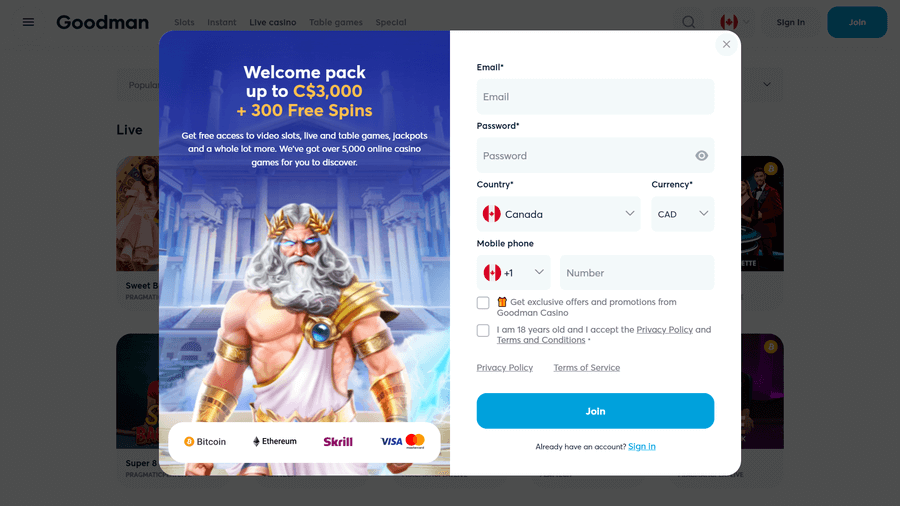
Setting up an account requires only a few minutes: an email, a password, and a few personal details finish registration, after which you’re prompted to choose a deposit method. I loaded my account with an e-wallet and the money arrived instantly, so I was able to jump straight into the blackjack lobby. The game library is organized logically, with a table games filter that divides blackjack variants from roulette and baccarat, and a live casino tab that organizes all the real-dealer tables. I valued being able to test some RNG tables before risking real money, though live dealer games naturally need a real-money bet. Once you choose a table, the loading time remained under five seconds on my connection, and the betting limits were clearly posted. If you are unfamiliar to blackjack, I’d suggest starting at a low-limit classic table to learn basic strategy before advancing to surrender-equipped variants or multi-hand formats. The platform recalls your preferred chip denominations and hand speed settings, so later sessions continue where you left off. From signup to your first double down, the process is straightforward, leaving you free to focus on the cards instead of fighting with the interface.